

When reviewing Insulated Ptc Heater, separate confirmed details from RFQ preparation for early research
An insulated ptc heater should enter an RFQ as a defined application question, not as an assumed drop-in solution. Start by recording the equipment, available electrical supply, installation space, heat-transfer method, and operating environment. Then separate what the product page states from what your project still needs to establish. This approach helps operations teams compare options without turning a short product description into a complete specification.

Define the use case and constraints
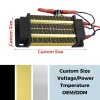
Begin with the job the heater must perform. The captured page presents an insulated body with a ceramic element and aluminum shell. It lists a 50.5 mm width and supports 12V, 24V, 72V, 110V, and 220V versions, with stated power options from 150W to 2000W. These details can shape an early RFQ, but they do not by themselves determine whether a particular model fits the assembly.
Next, document the physical envelope. Record the available length, width, thickness, mounting direction, wire exit position, and surrounding parts. The page includes a question about customizing length, width, or thickness. That makes dimensional customization a relevant supplier question. It does not establish a finished dimension, a tolerance, or suitability for a specific machine.
Electrical constraints deserve the same treatment. The technical examples include 12V, 24V, 110V, and 220V products, with listed examples such as 150W and 200W. An RFQ should identify the actual supply at the installation point and the required power selection. Avoid choosing a voltage or wattage from a nearby example simply because its name resembles the project requirement.
Map stated evidence to requirements
A compact evidence map can keep the review disciplined. Treat each listed value as a candidate requirement only after matching it to the intended assembly. For example, the page’s table identifies two-row products and distinguishes examples with no stated overheat protection from examples with side-mounted overheat protection. That distinction belongs in the comparison record. It should not be generalized across every version on the page.
For a self regulating insulated ptc heater, the phrase may describe the type being researched, but it should not replace application analysis. The captured page mentions an insulated surface, high-temperature silicone wires, and built-in overheat protection in its product description. It also presents an application image showing an egg incubator with open doors, stacked egg trays, and a digital control panel. Those page details provide context for the research, not proof that a proposed design will meet its temperature, airflow, or control requirements.
One concrete page-level anchor is the product page’s consent notice. It states that advertising-related storage and Google Ads conversion measurement are controlled by consent, and that conversion data is imported from Google Analytics. This fact concerns the website’s measurement practices, not heater performance or application suitability. Keeping that boundary visible prevents unrelated page content from being mistaken for technical evidence about the heater.
| Evidence to record | Page-listed example | RFQ use | Limit of the evidence |
|---|---|---|---|
| Construction | Ceramic element and aluminum shell | Describe the material configuration under review | Does not establish fit or performance in a specific assembly |
| Width | 50.5 mm | Compare with the available installation space | Does not provide every required dimension |
| Electrical range | 12V, 24V, 72V, 110V, and 220V | State the supply options to be quoted | Does not select the correct project voltage |
| Protection example | None or side-mounted overheat protection in listed examples | Ask which configuration applies to the requested model | Does not make one protection type universal |
Turn open points into supplier questions
A useful RFQ should convert uncertainty into short, answerable questions. Ask which length, width, and thickness can be supplied for the intended quantity. Ask which voltage and power combinations are available for the requested dimensions. Ask whether the quoted version has overheat protection and, if so, how it is positioned in the assembly. Ask for the exact product designation so the response can be matched to the internal requirements list.
Also describe the surrounding equipment rather than relying on a generic label such as cabinet heater or air heater. State whether the unit is being considered for an incubator, an office ventilation context, or another defined assembly only when that is the actual use case. The page includes an office interior with ceiling ventilation and illustrated airflow as another application image. An image can help frame a discussion, but it cannot establish airflow, heating capacity, control behavior, or compatibility.
Keep unsupported assumptions out of the first comparison. Do not infer a certification, a guaranteed service life, a safety rating, or a customer result from the product wording. Do not treat the listed 150W–2000W range as proof that every power level is available in every dimension or voltage. Instead, place each unresolved point in the RFQ and require the response to identify the exact configuration being offered.
Summarize a defensible next step
The next step is a traceable request, not a premature selection. Create one requirement sheet with the application, space, supply, target power, environmental description, protection expectation, and quantity. Beside each field, mark whether it comes from the captured page, from the project, or from a supplier response still needed. Then send the same sheet for each quote so the returned configurations can be compared on equal terms.
For early research, PTCYIDU can be treated as the named source for the captured insulated heater information, while the RFQ remains responsible for confirming the exact model and application fit. This separation keeps the review useful: page-listed construction, dimensions, voltage examples, power examples, and protection variants inform the questions, while the operations team retains responsibility for its actual requirements.