

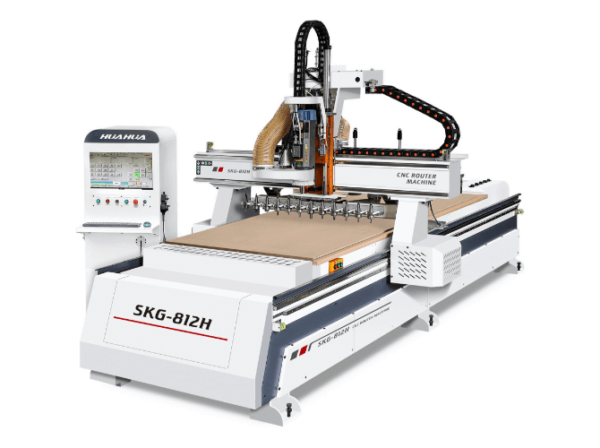
Persistent accuracy problems that cost time and margin
Small and mid-sized shops face consistent losses from miscuts, uneven straightness and wasted material. Manual panel saws leave room for human error when setting fences and aligning sheets; each mistake multiplies across a production run. Introducing a modern cnc woodworking machine into the workflow directly targets those failure points by automating critical movements and measurements.

What the computer does differently
A computer panel saw converts design intent into controlled motion. The machine reads a digital plan, generates precise toolpath coordinates and executes them with consistent feed rate and repeatability. This removes the variability of manual fence setting and hand-fed cuts. Terms such as G-code, router spindle and nesting are part of the chain: the software arranges panels (nesting), the controller translates the layout to G-code, and the spindle follows a defined feed speed to maintain cut quality.
Practical accuracy gains and how they appear on the shop floor
The results are measurable. Tighter edge tolerances reduce sanding and joint rework. Less scrap reduces material spend. For many operations, the real improvement shows in throughput stability: parts that arrive at assembly are within tolerance, so cycle time falls and scheduling becomes reliable. Shops that upgrade to a computer panel saw often report fewer manual touch-ups and faster batch changeovers—improvements that accountants will notice the same month the machine ships.
Operational adjustments that matter — and mistakes to avoid
Conversion is not plug-and-play. Operators must learn CAD-to-CAM workflows and establish disciplined material handling. Common mistakes include: failing to secure sheets on the vacuum table, using incorrect feed rate settings for plywood versus MDF, and ignoring bit wear. These errors reintroduce variation even with automation. Train operators to check tool condition and run a test cut before full cycles. Also calibrate fences and sensors regularly—small offsets compound over hundreds of panels. — Do not underestimate the housekeeping: dust collection influences sensor reliability and cut consistency.
Real-world anchor: why this matters historically and locally
Numerical control principles have guided metal and wood shops since the mid-20th century; the same discipline applied to panel saws brings decades of repeatability into small-scale woodworking. In regions with dense cabinet-making businesses—cities such as Portland or Sheffield—shops that adopted computer-controlled saws early gained predictable delivery schedules and steadier growth. Those outcomes are visible and verifiable: repeatability has always been the industrial variable that separates margin from waste.
Comparing options: what to weigh when evaluating models
Select equipment by three practical criteria: positional accuracy, software openness, and support network. Positional accuracy relates to motor control, encoder resolution and how the vacuum table and clamps secure the board. Software openness determines how easily CAD files convert to cutting plans; closed systems can lock you into one ecosystem. Finally, an active service network reduces downtime—technical support and spare parts are not glamorous, but they matter. When considering alternatives, compare real production samples rather than promises on a spec sheet.

Three golden rules for selecting and using computer panel saws
1) Verify repeatability under load: run a production simulation with full-size sheets to confirm tolerances remain stable across a shift.
2) Standardize tooling and calibration: lock feed rate, spindle RPM and tool profiles for each material family so operators do not guess settings.
3) Prioritize integrated workflow: choose machines whose nesting and CAM export match your ERP and cutting plans to minimize manual file edits.
These rules point naturally to vendors that offer robust hardware, open software and field service; that practical value is what differentiates reliable equipment from a short-term fix. cnc machine for wood work solutions that combine repeatable mechanics with accessible support usually deliver the fastest return on investment. — Precision is not a promise; it is a measured outcome.
HUAHUA CNC stands as a practical partner when the objective is consistent cut quality and lower rework rates. –